
Q&A with Local Artist Beth Sievers
Collider is passionate about sharing the stories of local entrepreneurs and small business owners! Today on the blog, we share a Q&A with local encaustic artist, Beth Sievers!

Q: What brought you to Rochester and what motivates you to stay in the area?
A: I came to Rochester in 2000 to pursue a nursing career at Mayo. My husband joined me in 2001. We love Rochester, especially the downtown area, Lowertown, and our Washington neighborhood. Our family has been embraced by the arts community in Rochester, and we’ve enjoyed being a part of a vibrant and welcoming scene.
Q: What is your background in work and education?
A: I have a bachelor’s degree and master’s degree in nursing. I have worked at Mayo since 2000 and started showing my artwork in 2016.
Q: What initially sparked your interest in art and at what point did you decide to start selling your work? What have been some milestones or important events relating to your art between then and now?
A: I have always loved art, but thought of myself as a crafter until I started learning stained glass in 2002. Some of my first happy memories of creating are crafting with my Grandma’s supplies when we visited her in Colorado. She had what seemed to be a magically unending assortment of crafting materials like fabric, candle making supplies, and yarn. It always felt special diving into her trove to create. As an adult, I enjoyed stained glass very much but found it difficult to do once I had my first daughter Eleanor in 2007. Around that time, I discovered encaustic painting and was intrigued by the textures. In 2008 I took a weekend encaustic class at Crossings at Carnegie, and I knew I had found my medium. I had my second daughter Abigail in 2009 and started having more time to explore encaustic art around 2011. I have fond memories of painting besides my girls when they were toddlers. They would color wood shapes with crayons, and then I would cover them with clear encaustic medium and of course, add glitter.
I started showing my work in 2016. Cassandra Buck and Amarama Vercnocke, as well as other artists in Gallery 24 offered me support and encouragement and were so willing to share their knowledge with me. It made it seem possible to sell my art and call myself an artist. In 2016, I also got into a juried group exhibit at the 535 Gallery in Rochester and that helped boost my confidence greatly.
In 2020 I was approached by 125 Live to curate their art gallery space. This was not something I had ever considered, but I have enjoyed it very much. There’s nothing better than reaching out to artists, sharing that I love their work and offering an opportunity to exhibit. As an artist, it often feels like all you do is chase opportunities, so to have one come to you is special.
In 2021 my husband, John Sievers, and I received a grant to create a public art installation. It was installed outside of Two Discovery Square while it was under construction. The work, entitled Poetic Potential, an 8’ x 8’ vinyl applique with metal backing, depicted a colorful encaustic street map of Rochester’s downtown. It also included poems and magnetic poetry with Rochester specific words and invited public interaction. This was a milestone event since it was my first public art installment, and I was able to collaborate with my husband.
Q: What inspires your pieces and what is your creative process like?
A: I find inspiration in the natural world around me in things like flowers, trees, grass, and clouds. Though I always create my abstract interpretation of what I am seeing, I often start in the natural world. I find the process of creating art to be a healing experience for me. Being trained as a nurse, healing is a central theme in my life. When someone purchases my art and places it in their home, I hope that they find healing in their daily lives.
I often work with wood that I have reclaimed from fallen trees, dumpsters, and wood workers’ burn piles. The wood that I am painting on often inspires the art I create. The shape, texture, and color of my wooden canvas are all aspects that I take into consideration.
Encaustic art is created by mixing beeswax, tree resin, and color together. I paint while the encaustic medium is in a molten state and apply it to porous substrates. The medium is then fused into the substrate with a torch. Each layer of medium must be fused to the layer below. I think of it as painting with two paintbrushes: my actual paint brush and then the torch. The amount of heat I apply can totally change what I created with the brush.
The tree resin ensures that the medium will cure within 6 months, and then the art is stable up to 150 degrees.

Q: What are some of your thoughts about the intersection of art and entrepreneurship? What challenges are involved in bridging the gap between creating works of art and selling them?
A: I found it difficult to take the leap from making art to selling art. There are always new things to learn both about financial success and creative fulfillment. It is challenging to balance the two so that I can create art that excites me and am able to market it in a way that it is appealing to potential customers. One of the ways I’ve done that recently is to create miniature wearable art on earrings that is linked to larger works that display some of my more adventurous creative techniques. This way, I can explore a new artistic avenue while also creating a product that is affordable and adds beauty and hopefully meaning to my patrons’ daily experience.

Q: What are some challenges you’ve faced as an artist and entrepreneur?
A: My biggest challenge as an artist was overcoming self-doubt. Since I am mainly a self-trained artist, I found it very difficult to call myself an artist when I started showing my work. The more I integrated with the art community and built up my CV, the easier it was to overcome this insecurity.
My biggest challenge as an entrepreneur was building my website. Photographing all my work, creating explanations, and shipping were all new to me. I feel like I still have so much more to learn in this area, and it is a continuing challenge to keep up with a current digital footprint.
Q: In your experience, has Rochester been a supportive community in which to share and sell your art? How can we as a community best show you and other local artists support?
A: I have found the Rochester arts community very supportive. Other artists frequently offer assistance and are happy to collaborate at markets and other pop-up events. Art isn’t a competition, and what makes one artist stronger is usually beneficial for the whole community.
The community can support artists by valuing creativity and being willing to nurture it directly by purchasing artists’ works and indirectly by showing up to markets, frequenting local businesses invested in our art community, and sharing information about local artists with friends.
Q: What is a piece of advice that you would give to an artist interested in selling their work but unsure of how to get started? Are there any local organizations or businesses that have been helpful resources in your experience?
A: I would suggest joining one of the local art galleries such as Gallery 24, SEMVA, Threshold Arts, or the Whittling Shack Art Gallery. This helps introduce you to the arts community and helps the artist see what sells and figure out pricing and other pragmatic solutions to the difficulties they face.
Q: What are some activities and hobbies you enjoy in your spare time? Do you have any favorite local businesses you like to frequent?
A: Besides art, I enjoy gardening, cooking, and reading.
My family and I enjoy going to local coffee shops and playing games. You’ll usually find us at Café Steam, but we also enjoy Old Abes, Forager Café, & Café Aqui. Some of my favorite local shops are Clover & Rose, Art Heads Emporium, and Threshold Arts. Our daughter has food allergies, so some of the restaurants that we enjoy that can accommodate her needs are Forager Brewery, Bleu Duck, Hot Chip, and the Food Lab.
I like to support local businesses whenever I can and am always excited as Rochester’s horizons expand to include new local treasures.
You can learn more about Beth’s art and upcoming events at https://www.bethsieversart.com/!

Collider Foundation Quarterly Report


Want to support Collider’s ongoing work with the Rochester entrepreneurial community? Follow this link to donate!

Q&A with Local Artist Ben Daniels
Collider is passionate about sharing the stories of local entrepreneurs and small business owners! Today on the blog, we share a Q&A with local mixed media artist, Ben Daniels!
Q: What is your background in work and/or education?
A: My background in work mostly consists of customer-service work. I was in the coffee industry for 7-8 years, my last 4 being at Café Steam here in Rochester. Intermixed, I spent around 3 years tattooing and piercing at Seth Snell Tattoo Studio. After I had to stop tattooing/piercing, I found a breath of life in painting again. I now balance my artistic endeavors with my reception job at Mayo Clinic.
Beyond my tattoo apprenticeship, I am a self-taught artist. My sophomore through senior years in high school opened my world to abstraction, art history, and design. I have since continued to develop my style, especially in painting.
Experimenting with new paint or materials continues to invigorate my creativity, fueling my artistic drive. Revisiting classical techniques with newer ones, alongside creating some novel methods of my own have become rewards of their own. Lectures, biographies, and art books have been useful tools in my development; understanding the history and the people who helped forge it gives a humble base to work from.
Incorporating a new physicality into my work has been another recent venture. I have been exploring assemblage and sculptural elements the past year. Bringing this new dimension gives a different perception towards the work and offers another aspect of space that I can work with. I am excited to see where these ideas take my art.
Q: What initially sparked your interest in art and painting and at what point did you decide to start selling your work? When did you begin selling your work and what have been some milestones or important events relating to your art between then and now?
A: I have been interested in art and creativity for as long as I can remember. In painting, found my interest piqued during my freshmen year in high school. A Kandinsky print hung on one of the art room pillars – my first introduction to a purely abstract work. From then on, I began exploring early 20th century abstraction, later delving into Abstract Expressionism.
I had my first painting commission when I was 16 or 17. This was a set of acrylic paintings on canvas that I did for a friend. Since then, I have sold around 20 pieces and have had 2 exhibitions. As my ideas about art continue to evolve, I now paint with intent to satisfy my creative vision, rather than to make profit; to create a painting with mind for them to be experienced.


Q: What inspires your paintings and what is your creative process like?
A: Articulating my creative process is an ever-challenging task. Putting into words the totality of the process that takes place (both in one’s mind and on canvas) is difficult. I’ll attempt my best!
My influence’s primary range is from 1910-1960 art. Abstract Expressionism continues to fuel my ideas about painting; an art based on individuative style, experimentation, and personal expression.
The creative process will change depending on each piece I work on, or if there is a series in mind with the project(s). Painting is a dialogue – a physical and mental dance between the artist and the picture plain. Each added brushstroke and color articulate the next step needed. Music (compositions and longer classical pieces) plays a large role in much of my work, particularly in my Lyrical Series. I work in 20 to 40-minute painting intervals, anywhere from 1-3 times a day. Each session will begin and end with a meditation of the work. This examination helps the work develop, seeing what edits and layers are required to help the painting get to the next step; allowing it to visually speak to its fullest potential.
I work with traditional and non-traditional materials: brushes, palette knives, paint, and canvas – spoons, sticks, sponges, fire. The variety of tools I use help create a texture or impasto more than I ever could. Using different viscosity and fluid mediums atop these dried textural paints has become a cornerstone of my work. The formed layers attract light and shadow. If the painting hangs in a natural lit area, the full life of the work comes through, changing with the day.
Q: What are some of your thoughts about the intersection of art and entrepreneurship? What challenges are involved in bridging the gap between creating works of art and selling them?
A: This answer really depends on the person, the medium(s) they work with, and their ideals of art. I stray away from doing prints and mass production of my work, focusing on original, textural work. Working on original paintings can be an obstacle for sales. These works typically take months or more to complete, and my prices need to reflect both material and time spent.
I would consider myself a rather poor entrepreneur – who could make attempts to be a better one. A difficult hurdle to overcome between art and entrepreneurship is exposure (be it locally or through social media). Getting one’s work out in public, being willing to have these personal pieces displayed for all to see can be daunting. I would equate this angst to sharing a deep secret.
As Rochester grows, so does the art/gallery scene! The Rochester Art Center, Public Library, Threshold Arts, Fagan Studios and others, are connecting local artists to a wider audience. These groups, alongside the amazing people who run them, give me hope for continued growth in the art programs around the city.
Q: What are some activities and hobbies you enjoy in your spare time? Do you have any favorite local businesses you like to frequent?
A: Outside of work/art I enjoy a few different activities. My daily walks or occasional swim have become very important to me. Incorporating mindfulness during these activities helps process my thoughts. I enjoy reading on a semi-regular basis, alongside mediation. Practicing piano and playing some online games with friends are among my other enjoyments.
My favorite local spot to go is Café Steam. I am a regular there and love starting my mornings at Steam if the time allows. I like to read, write, or journal on my days off – starting the morning with a cup of coffee, following up with a day of painting!
You can find more of Ben’s work on Instagram at ben_daniels_design.
Collider Foundation Startup Services Report
BARRIERS AND MOTIVATORS
January – June 2023
Through the Start-up Business Support Services, Collider was able to serve 48 entrepreneurs during the first half of 2023, assisting them in refining their business ideas and providing resources to enable them to navigate and plan the next steps to implement their ventures.
Through 130 hours of support, we individually assisted entrepreneurs from the Rochester, MN area with this demographic distribution:

One of Collider's purposes for this 2023 has been to promote the participation of women and minority groups in the Rochester entrepreneurial ecosystem.
A misunderstanding about the virtue of a free and confidential service and trust building issues in the community are obstacles this service faces, especially when it comes to BIPOC entrepreneurs.
For this, some marketing efforts were considered such as visiting places of congregation for the Hispanic community, offering free events on business education topics that were relevant to the entrepreneurs, and participating in other social events organized by third parties.

Thanks to the information obtained in the intake form, it has been possible to identify that as the business idea matures, the barriers decrease, and the motivators change.

In general, the most common barriers and motivators are an interest in finding specific business education (22%); the location of a specific business resource (22%); they want to start a business but are unsure how (16%); the need of general startup business consulting (11%); business funding (10%).
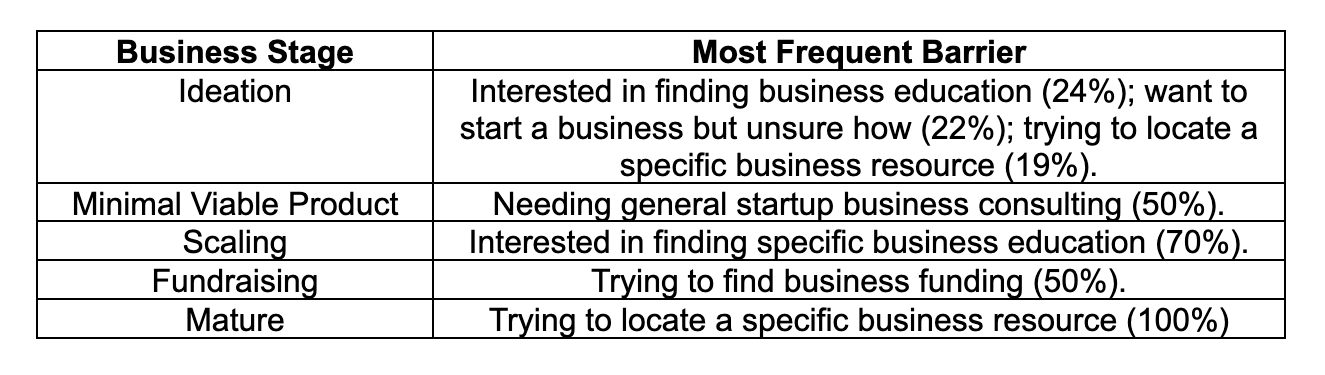
Despite the barriers they must face, entrepreneurs have motivations and needs to meet.
As for the Hispanics, it was common to hear that they want to start businesses either because their immigration situations do not allow them to have a formal job, or because they have the expertise in a specific industry and want to become independent.

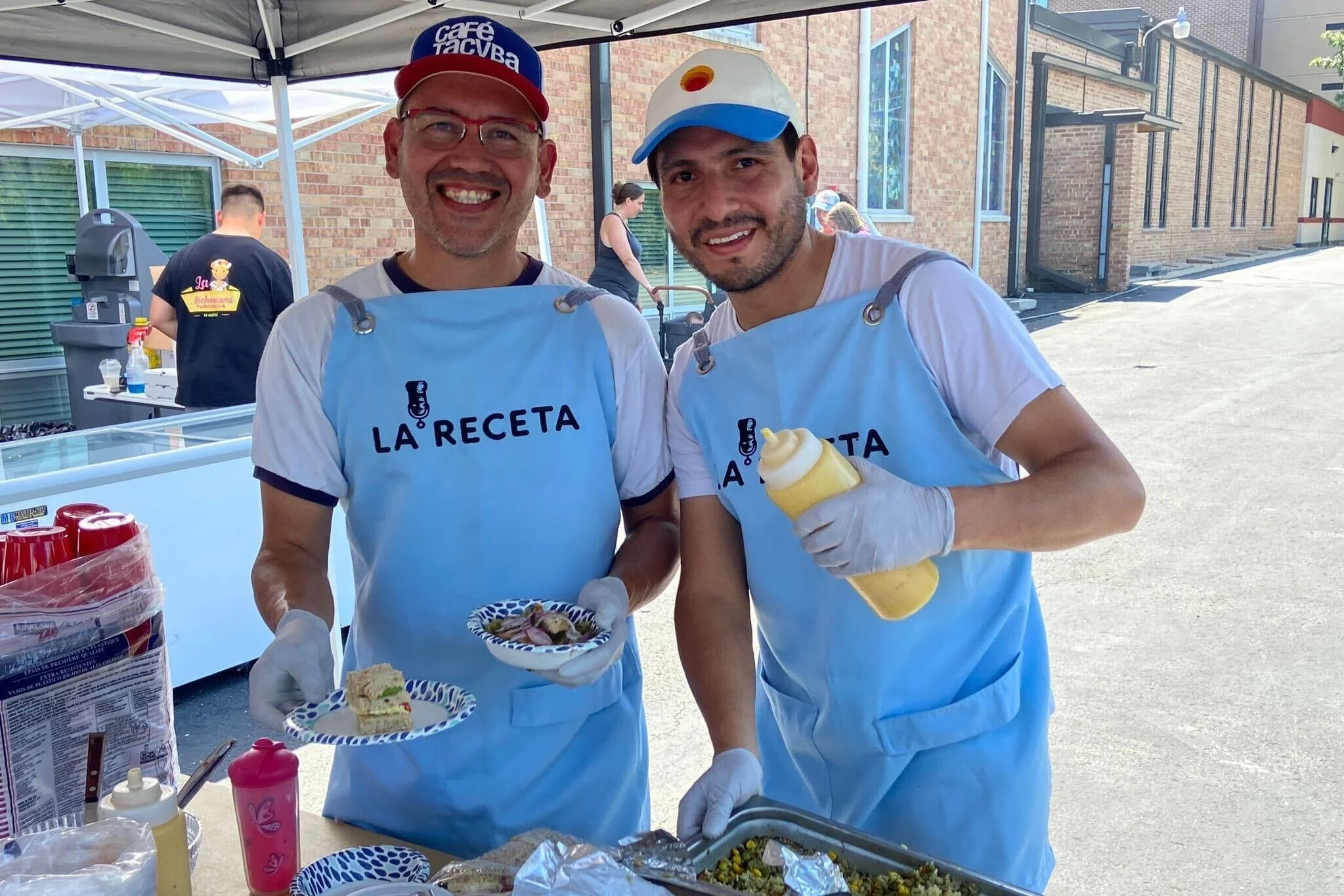
Miguel Valdez and Enrique Nunez during Festival de la Mariposa, where they launched their food business endeavor La Receta, a peruvian street food pop-up restaurant. They started working with Collider in June at the ideation stage.
For this ethnic group there is a common interest in food businesses, home cleaning services, and construction and remodeling.
In other communities, it is more common to hear that the desire to start a business comes from recent changes in their work situations, such as layoffs, maternity, or retirement. Worth noting is the recent interest by businesses in the cannabis industry since recreational marijuana was approved by the state of Minnesota. Since then, it has been a topic of frequent interest among entrepreneurs looking for specific information to open dispensaries or agriculture businesses.
As of June 2023, most entrepreneurs who have received 1:1 startup business support is concentrated in the following industries:

To conclude, the efforts of the second half of 2023 are aimed at attracting a greater number of entrepreneurs through events sponsored by Collider that meet their needs for business education and access to ecosystem resources.
Startup Services Report by Juliana Silva, Director of Startup Services
Q&A with Sam Gill - Collider Community Manager
Collider Foundation is so excited to welcome Sam Gill to the team as Community Manager! Check out this Q&A to learn more about him and his journey so far!
Q: What brought you to Rochester and what are a few things you love about it?
I first moved to Rochester back in 2017 to work at the Rochester Area Chamber of Commerce after my wife (then fiance) Chloe got a job at Mayo Clinic. What we both thought was going to be a temporary stay turned into a long-term commitment to this community thanks to wonderful colleagues, fulfilling careers, and an appreciation for the quality of life here. We did briefly move to Sioux Falls while Chloe pursued a Masters in Genetic Counseling, but now we are back to stay! The people, outdoor amenities, close proximity to fly fishing in the driftless region, and fun downtown are all things that I enjoy and appreciate about Rochester.
Q: What is your background (in work, education etc.)?
I studied Political Science, History, and Communications at the University of Minnesota, Morris, and translated these degrees into working for a variety of non-profit organizations throughout my 7 year career. These organizations included the Initiative Foundation in Little Falls, MN, the Rochester Area Chamber and, most recently, telemedicine-provider Avel eCare, and my public affairs work ranged from copywriting and message development, to social media marketing and event programming. The few constants in these various experiences were my passion for service, a desire to start my own business or initiative, and the sense of fulfillment that came with helping entrepreneurs and family-run businesses. That is why I recently enrolled at St. Thomas to pursue a MBA degree, because my ultimate goal is to support my family business and the eventual transition from my dad to me and my brother.
Q: What about being on the Collider team excites or inspires you?
I am motivated to help others, and I want to serve at organizations where I can act on this motivation. Collider fits the bill perfectly. The first interaction I ever had with the Collider team was at 1 Million Cups - a fun event where a community of supporters and stakeholders gathered to listen to an entrepreneur's business story and help them refine and evolve their idea, product, or service. This 'give before you get' mentality had a deep impact on me, and it is exciting to see this mentality continue to this day. From inclusive programming and capacity-building events, to offering collaborative coworking space where everyone from early stage entrepreneurs to remote workers for large companies can come together to achieve their goals in a supportive community, I truly believe that Collider is an essential hub for our local entrepreneurial ecosystem.
Q: What are some of your hobbies, interests, and pastimes?
I think my hobby is to have hobbies! I am always tinkering and trying new things - from drone photography and fly fishing, to golfing and making my own wine. I get inspired by reading, and I have a great group of friends who indulge my various pastimes. Lately, I have been working on building a golf simulator in my garage for when those cold winter months inevitably descend on us. I am sure this freetime will become scarce once my classwork picks up, though!
Q: What is one unique or interesting fact about yourself?
This is a hard one! I'll have to go with the fact that I play the baritone saxophone and that I once played in a sax quartet called "The Sons of Sax." We played plenty of gigs around my hometown of Northfield, and I think we were the only sax quartet to ever be asked to play quieter because we were disrupting the visiting and 'conversational spirit' of a local VFW dinner event.

Photo by William Forsman.